
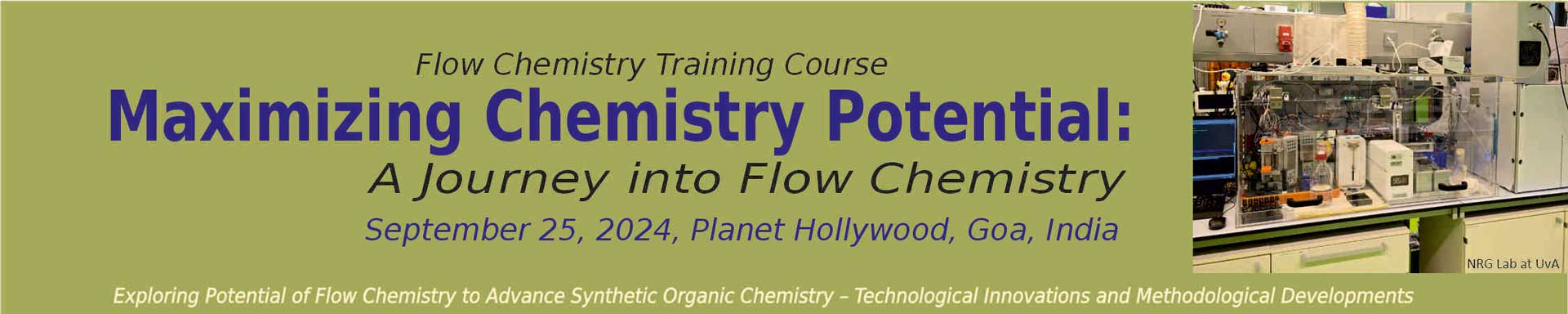
Flow Chemistry Training Course – Maximizing Chemistry Potential
About the Course
Flow chemistry represents a transformative approach within synthetic organic chemistry, leveraging continuous streams of reagents introduced by pumps and mixed in reactors like plug flow reactors (PFR) or continuous-stirred tank reactors (CSTR). Departing from traditional batch processing in round-bottom flasks, this method offers a myriad of advantages: improved mass and heat transfer, enhanced safety protocols, increased reaction efficiency, waste reduction, scalability improvements, and enhanced reproducibility. Consequently, flow chemistry enables precise control over reaction conditions, facilitating real-time monitoring and analysis of reaction kinetics, culminating in superior product quality and streamlined processes.
While initially met with scepticism within the synthetic community, the induction period for its implementation stemmed from factors such as a perceived lack of interdisciplinary knowledge, complexity, and high investment costs. However, recent advancements in technology, including "Do It Yourself"-assembled flow setups, 3D-printing, and affordable electronic toolkits, have democratized access and streamlined the adoption of flow technology. This is especially relevant given the surge in popularity of photo- and electrochemistry, where flow technology effectively addresses scalability challenges and safely conducts reactions with hazardous reagents, thus expanding chemical frontiers.
This course aims to empower researchers, particularly those from industry by providing basic guidelines for utilizing continuous-flow reactors. Through concise explanations and relevant examples, we endeavour to demystify this technology and its application, fostering broader adoption within the synthetic community and showcasing its potential to revolutionize research practices.
In addition, this course will also cover the demonstration of practical aspects of setup of a typical flow reactor.
It will be held on September 25, 2024, and is brought to you by the organizing team of Flow Chemistry India conferences in since 2012. Each participant will be given a certificate signed by Prof Timothy Noel and also a comprehensive set of notes in pdf file consisting of the material presented in the session.
Course Contents
Session 1: The basics: why and when to select flow technology, the importance of mass and heat transfer
Session 2: Chemical reactions and synthesis in flow reactors
Session 3: Photo and electrochemistry
Session 4: Self-driving labs. The automation of flow chemistry, implementation of optimization algorithms and machine learning, closed-loop optimization
Session 5: From laboratory to industrial scale – scaling flow technology.
Live-Demo of Flow Reactor Set-up by Company (Working of the reactor, Set-up, and accessories - Pumps, Pressure Regulators, Heating & cooling units, Temp. & Pressure Indicators, Mass Flow indicators, Accessories, flow homogenous and heterogenous pumps, Downstream Integration)
Who Should Attend?
This course is tailored for:
Chemists, Chemical Engineers, and Scientists from Academia and Industry: Ideal for those actively engaged in research within Chemical Synthesis, Bio-processing, Pharmaceutical, Fine Chemical, Agrochemical, Petrochemical, or related fields. This includes professionals specializing in Medicinal, Organic, and High-throughput Chemistry, as well as those involved in Process Development.
Prerequisite Knowledge: Attendees should possess a foundational understanding of chemical synthesis to fully benefit from the course content.
What will I Gain by Attending?
By participating in this course, you will:
Receive a State-of-the-Art Introduction and Training: Gain comprehensive insights into continuous flow synthesis, including a deep understanding of the concepts, processes, and functionality of continuous reactors in organic synthesis.
Acquire Familiarity with Various Reactions and Organic Synthesis in Flow: Explore a diverse array of reactions and learn how organic synthesis is conducted within the framework of flow chemistry, enhancing your versatility and proficiency in the field.
Explore Applications, Advances, Challenges, and Solutions: Delve into the applications, recent advances, prevalent challenges, and effective solutions in the realm of flow chemistry, equipping yourself with the knowledge and strategies necessary to navigate and excel in this dynamic field.
Organizing Secretaries
Ms Swati Kanwar; E: s.kanwar@glostem.com; M: 8289015050
Ms Farheen Zainab; f.zainab@glostem.com; M: 7696225050
WhatsApp: 9041725050 for more information.

Conference Date
25-09-2024



Speakers & Panelists
Venue
Planet Hollywood Beach Resort, Goa
Address: 30/3, Acsona Waddo, Uttorda Beach, Salcette Goa - 403 713 India





Planet Hollywood, a beach resort in south Goa, has rooms that are equipped with unique design features. These rooms feature mood lighting facility that enable to set the mood for the room in the evening .These room feature king as well as twin beds with signature furnishing and a glass partition which separates the room and bathroom. You can choose an option of rooms overlooking the Arabian Sea, Swimming Pool and Natural Greenery all around.
Retreat in style in the luxury sea view chalets at Planet Hollywood Beach Resort Goa. The perfect place for a tranquil romantic escape or a getaway with friends and family. Unwind in a chic accommodation exquisitely designed with all modern amenities along with a breathtaking oceanic view to make you feel like you have entered a whole new world altogether!
Glostem has negotiated special room rates for the conference attendees. For details please contact the Glostem team.